
Learn about our Programs, including information about bond offerings, ratings, CUSIPs, and more.
Get Issuer Alerts
Add this issuer to your watchlist to get alerts about important updates.
Learn about our Programs, including information about bond offerings, ratings, CUSIPs, and more.
Chicago General Obligation Bonds
- Sector
- County / City / Town
- Sector
- County / City / Town
The City of Chicago is a municipal corporation and home rule unit of local government and, as such, “may exercise any power and perform any function pertaining to its government and affairs including, but not limited to, the power to regulate for the protection of the public health, safety, morals, and welfare; to license; to tax; and to incur debt” except that it can “impose taxes upon or measured by income or earnings or upon occupation” only if authorized by statute.
As of December 31, 2025, the City had $5.36 billion of General Obligation Bonds, $551.8 million of General Obligation lines of credit, and $8.7 million of other general obligations outstanding. In 2025 the City issued General Obligation Bonds Series 2025A through 2025E, along with Housing and Economic Development Projects Series 2025F and Taxable Series 2025G. In March 2026 it sold $511.9 million of General Obligation Bonds, 2026 Taxable Series A and B. Proceeds were used to finance a portion of the capital improvement program, refinance outstanding lines of credit, finance retroactive wage increases arising from collective bargaining, fund settlements and judgments, fund capitalized interest, and pay costs of issuance.
The City levies property taxes for general obligation debt service. Under a 1993 City ordinance, increases in the City’s aggregate property tax levy are limited to the lesser of 5% or the increase in the Consumer Price Index. Most general obligation bond levies approved after 2001 are excluded from that limit.
Chicago Water Bonds
- CUSIP-6
- 167736
- Sector
- Water / Sewer
- CUSIP-6
- 167736
- Sector
- Water / Sewer
The City of Chicago operates a municipal water system that provides supply, treatment, and distribution of water to customers in the City and 120 suburban communities over approximately 800 square miles and a population of 5.3 million. The system provides Lake Michigan water to 494,685 accounts in the City and its suburbs. It operates two water purification facilities with a combined pumping capacity of 2,160 million gallons per day and 12 pumping stations with a combined pumping capacity of 3,661 million gallons per day.
Water rates increased 3.37% on June 1, 2024 and 4.00% on June 1, 2025. The City’s Water Revenue Bonds are secured by system revenues. The ordinances authorizing the bonds require that net revenues available for bonds each fiscal year equal at least the greater of (i) 120% of the aggregate debt service on outstanding senior lien bonds, or (ii) senior lien debt service plus 110% of second lien debt service, plus debt service on IEPA loans, commercial paper notes, and any line of credit. The requirement was met at December 31, 2025.
The City sold $943.1 million of Water Revenue Bonds, Series A, B, and C, in May 2026 to finance a portion of the Water System’s capital improvement program and refinance certain outstanding bonds. Water and sewer capital funding totals $2.3 billion, or 12.5%, of the 2025–2029 Capital Improvement Program. It comes from enterprise funds, revenue bonds, Illinois EPA loans, and the Water Infrastructure Finance and Innovation Act (WIFIA) loan program, which supports lead service line replacement.
Chicago Wastewater Bonds
- CUSIP-6
- 167727
- Sector
- Water / Sewer
- CUSIP-6
- 167727
- Sector
- Water / Sewer
The City of Chicago is responsible for the operation, maintenance, repair, improvement, and extension of the City’s sewer system. The municipal sewer system provides sewage and drainage collection and conveyance for a service area of 230 square miles and 2.7 million people. It serves residents and businesses in the City and certain suburban customers, and transports wastewater to the Metropolitan Water Reclamation District of Greater Chicago for processing and disposal.
Sewer rates increased 4.00% on June 1, 2025. The ordinances authorizing the Wastewater Transmission Revenue Bonds require net revenues available for bonds each fiscal year to equal at least 115% of senior lien debt service, plus second lien debt service, plus 115% of debt service on IEPA loans, plus debt service on any wastewater line of credit and commercial paper notes. The requirement was met at December 31, 2025.
Chicago O'Hare International Airport Bonds
- Sector
- Airports
- Sector
- Airports
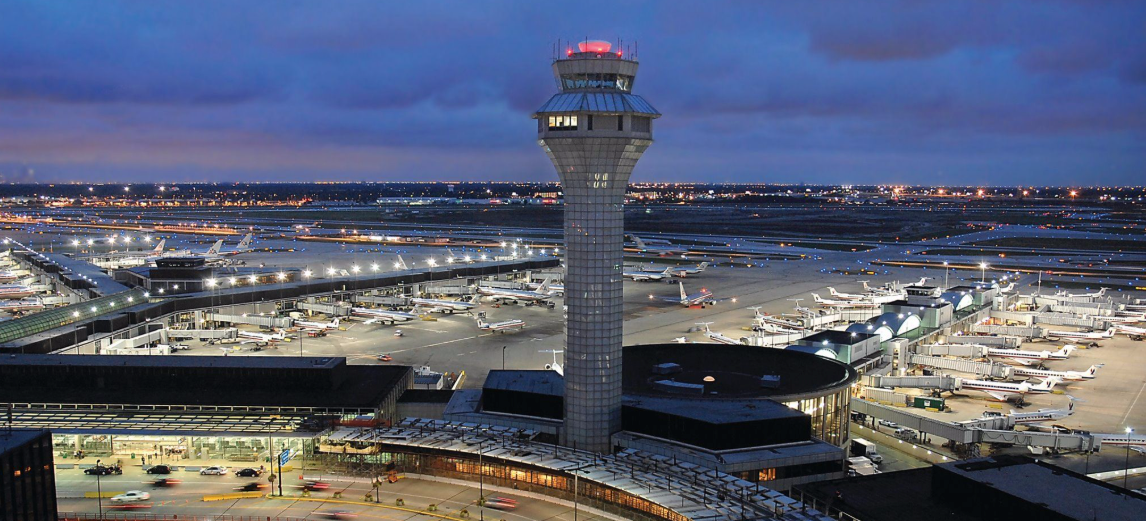
Chicago O’Hare International Airport is the largest commercial-service airport serving Chicago and the surrounding region, and the City’s primary commercial airport. It has eight active runways and four terminal buildings with 201 gates. Three domestic terminals have 170 gates and serve most domestic flights and certain international departures. Terminal 5, with 31 gates and four hardstand positions, serves the remaining international departures, all international arrivals requiring customs clearance, and additional domestic flights.
In 2025 O’Hare handled about 84.8 million passengers, ranking sixth in the world, and recorded 860,015 aircraft operations, the most in the world. It offered nonstop service to about 267 destinations, 198 domestic and 69 foreign. The airport operates under signatory airline use and lease agreements and non-signatory airline lease agreements. Airline charges include landing fees, terminal rentals, joint use fees, terminal ramp fees, equipment and fuel usage fees, and federal inspection service fees.
General Airport Senior Lien Revenue Bonds are secured by airport revenues. Under the Master Indenture, the City sets rates and charges so that revenues, together with other available moneys, cover operation and maintenance expenses and the greater of required fund deposits or 1.25 times aggregate debt service. The requirement was met at December 31, 2025. Passenger Facility Charge obligations and Customer Facility Charge Senior Lien Revenue Bonds are secured separately under their own indentures. Special facility revenue bonds issued for airlines and other parties are secured solely by payments from those parties.
Planning continues on the ORDNext program, which includes the Terminal Area Plan expansion and the Terminal 5 expansion. In February 2026 the City sold $612.2 million of General Airport Senior Lien Revenue Bonds, Series 2026A, to finance a portion of the airport’s capital improvement program.
Chicago Midway International Airport Bonds
- CUSIP-6
- 167562
- Sector
- Airports
- CUSIP-6
- 167562
- Sector
- Airports
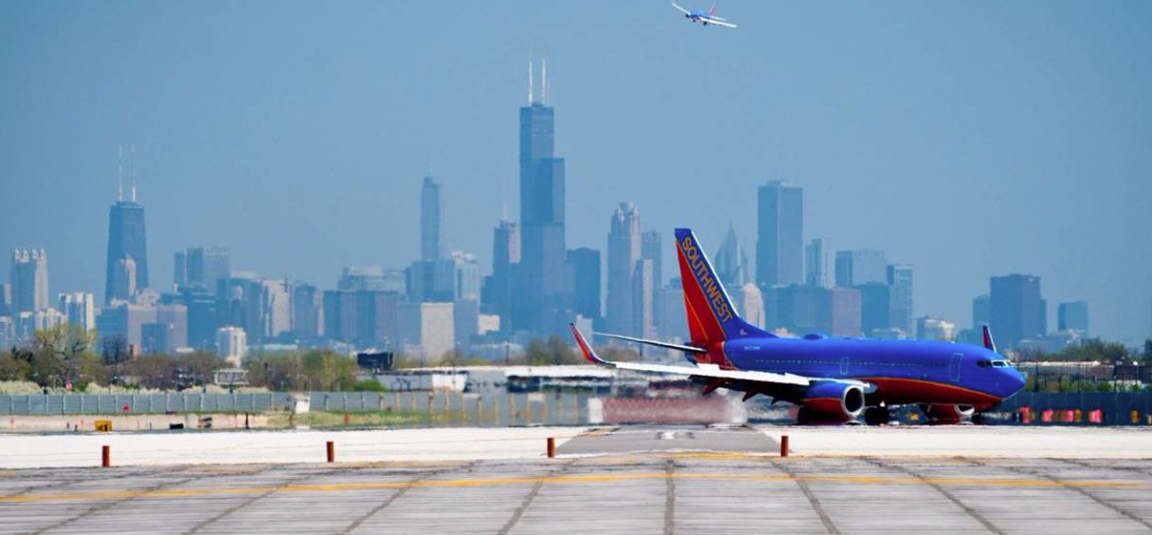
Chicago Midway International Airport provides regional travelers with access to airlines that generally specialize in low-cost, point-to-point, origin and destination passenger service. It is located 10 miles from downtown Chicago and encompasses approximately 840 acres. The airfield has five runways, two of which serve airline operations, and both airline runways have instrument landing systems. The one-million-square-foot terminal and connected concourses have 43 gates, three of which can serve inbound international passengers. Public parking includes a terminal garage with about 2,470 spaces and long-term economy parking with 8,842 spaces.
Midway operates under signatory airline use and lease agreements and non-signatory airline lease agreements, with airline charges that include landing fees and terminal rental and use charges. Operating revenues increased 7.3% in 2025, driven by higher landing fees and terminal rentals, offsetting a decline in enplaned passengers.
Midway Airport Revenue Bonds are secured by airport revenues. Under the Master Indenture, the City sets rates and charges so that revenues, together with other available moneys, cover operation and maintenance expenses and the greater of required fund deposits or 120% of aggregate senior lien debt service. The requirement was met at December 31, 2025. At December 31, 2025, $124.7 million of variable rate bonds were outstanding.
Chicago Sales Tax Securitization Bonds
- CUSIP-6
- 79467B
- Sector
- County / City / Town
- CUSIP-6
- 79467B
- Sector
- County / City / Town
The Sales Tax Securitization Corporation (STSC) is a special purpose, bankruptcy-remote not-for-profit corporation organized under the Illinois General Not For Profit Corporation Act of 1986 and an ordinance adopted by the Chicago City Council on October 11, 2017. It is an instrumentality of, but separate from, the City. STSC is governed by a board of directors with five voting directors, all of whom are City officials, and certain actions require the vote of an independent director appointed by the Mayor.
Under a sale agreement authorized by Illinois law, the City sold STSC its right, title, and interest in certain sales tax revenues. These “Sales Tax Revenues” consist of Home Rule Sales Tax Revenues, from three taxes the City imposes under its home rule powers, and Local Share Sales Tax Revenues, from four taxes imposed by the State. The State of Illinois Department of Revenue collects the revenues and the State is directed to pay them to the trustee, The Bank of New York Mellon Trust Company, N.A. Sales taxes collected by the City itself are not part of the pledged revenues. The City holds a residual certificate for revenues in excess of debt service and administrative costs, and bondholders have no claim on those residual revenues.
STSC bonds are limited obligations of the Corporation, payable solely from the Sales Tax Revenues and other pledged collateral, and are subject to a statutory lien. They are not a debt of the City or the State, are not backed by the full faith and credit of either, and STSC has no taxing power.
STSC issues senior lien, second lien, and third lien bonds under a Master Trust Indenture dated December 1, 2017. Additional bonds require that audited Sales Tax Revenues for the most recent fiscal year be at least 400% of maximum annual debt service for senior lien bonds, 175% of aggregate maximum annual debt service on senior and second lien bonds for second lien bonds, and 135% of aggregate maximum annual debt service on senior, second, and third lien bonds for third lien bonds. Audited fiscal year 2025 Sales Tax Revenues were $1.02 billion. After the October 2026 financing, that provides about 4.84 times coverage of maximum annual debt service on the senior lien bonds, and about 2.01 times on the senior and second lien bonds combined.
STSC had $5.99 billion of bonds outstanding at December 31, 2025. Its most recent issuance, in October 2026, was Third Lien Refunding Series 2026A Bonds and Senior Lien Taxable Refunding Series 2026B Bonds, with proceeds conveyed to the City to refund or refinance certain outstanding general obligation bonds.